Wednesday, 22 August 2018

352 : Northern House Martin


House Martin - Delichon urbicum

I am writing this from the sunroom of our holiday cottage in Boot, Eskdale Valley in the Lake District. We have come back to the South-West Lakes (taking the Wainwright delineation) for the third time in 10 years.


Our cottage is a stone built affair with half metre thick walls. The view is spectacular - a rock, scree and wooded ridge line alternatively clothed in mist and cloud or bright against the cold sky. In the bottom of the Esk valley the eponymous winding mountain river and a ribbon of deciduous woods.

A walk this morning discovered Roe Deer, a toad and a huge mixed feeding flock of tits;coal and willow tit, great and blue all mixed in together.

The pastures hold a good variety of old fashioned cow breeds and with them flies and hirundines.

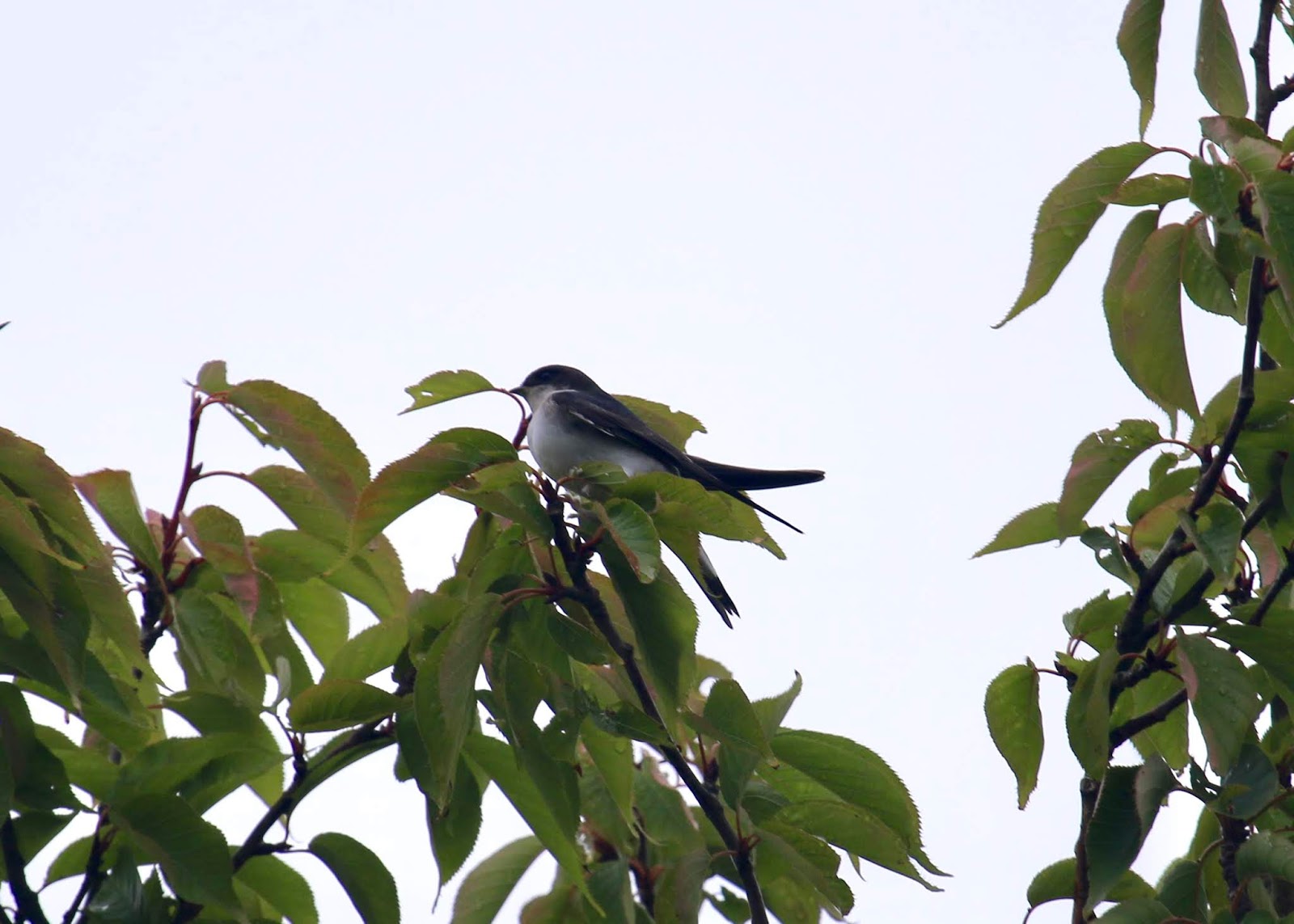
I am delighted to see the tree in the corner of the short lawn area dripping with House Martins - newly fledged and waiting to set out on the long haul back to Africa.


I have never seen them perch in a tree before - the swallows are collecting on the top wire of the fence in a nearby cow pasture but the Martins seem to collect in the tree every hour or so before heading out again to fatten up. Even in the misty Lakeland weather they seem to be content hawking for insects at 5-20 m The swallows are buzzing the ground but the martins seem more to cruise around in loose flocks at tree height or more. 


House Martin, Delichon urbicum
Boot, Eskdale, Cumbria
22 August 2018

Sunday, 12 August 2018

351 : African Harrier-Hawk


African Harrier-Hawk - Polyboroides typus

The South Luangwa National Park is the largest safari destination in Zambia. Situated half way up the course of the relatively unspoilt Luangwa river valley. The park has been in operation since the 50's. Our camp, Chinzombo was a permanent camp set on an oxbow lake right on the river towards the Southern end of the park. On one of our 5 days we elected for a big adventure driving North for an all day trip with a packed lunch. We ventured into the Lion plain - an area where the camps were already closed as the rains were setting in. The result ? We had the whole park, an area perhaps the size of an English County, all  to ourselves ! At some points we worked out that we were probably 30 miles from the nearest other human beings. Deep into the bush.

Some of the most beautiful features of the park are its ebony glades. The trees line up alongside historic water courses. We were lucky enough to take in quite a few of these during our big adventure. Simon Barnes, the excellent sports and travel writer has written a book called the Sacred Coombe which focuses particularly on South Luangwa with which he clearly fell in love. The premise of his book these secret spiritual places and journeys. Not in any hippy sense but just a personal and quiet spiritual sense - renewal through these secret hidden beautiful spaces in nature. These are the places and moments we need to seek out to remain whole in this world.


I forget the name of each "glade" - the combination of beautiful shade and trees though was stunning - entirely different from the usual "Miombi" or Acacia shrub that we are used to traveling through in Africa. You wouldn't have felt out of place sat next to some form of African elf. I haven't paid enough attention to trees in my life - utterly deserving or portraits. Family portraits here.


Before I get onto the encounter with the African Harrier-Hawk I had a lovely photo session with a buffalo attended by a Yellow-billed Oxpecker.


This is first time I have actually looked at a buffalo properly through a lens.


And this was the shot I wanted. Riding as if in the turret of a tank - or perhaps some undersized jockey in a bizarre race. In any event entirely in command of its vehicle or mount - or  so it thinks ! I love this picture - it goes into a safari top ten of shot so far in my life.


That is a big lump of beef. It was a long day with some fantastic encounters. The Harrier-Hawk was spotted soon after resting on the sandy bank of a lake edge. A long way off so you will excuse the quality of the pictures.


The face on the his bird is flushed red - I am not sure if this is associated with males in breeding or why this happens. The overall plumage a very smart grey with a barred front.


The bird then flew and I did my best to crank out some shots in flight that allow a solid identification. These birds are quite long legged and adapted for winkling out nestlings and lizards from cavities and chicks from weaver nests. They are often seen dangling upside down in order to access difficult sell spaces.


These birds are fairly widespread with a population of a million spread across the bulk of Sub-Saharan Africa. Still a first for me and better picture is needed.


African Harrier-Hawk, Polyboroides types
South Luangwa National Park, Zambia
November 2018

Saturday, 11 August 2018

350 : Kittlitz's Plover


Kittlitz's Plover - Charadrius pecaurius 

Yes there has been an almighty dearth of posting for the last few months. This whole project has just ground to a halt really. The main issue in my head is the way that the collection is now scattered across two sites. It would be a shame to let that throw me though so I am going to keep plugging away and catch up at least the photos that I have on the stocks.

November 2017 Jane and I took a ridiculous trip to the South Luanga National Park in Zambia. "Ridiculous" in that we went on our own minus the boys (who both now board in the UK) and that we went a little bit high end at a camp called Chinzombo - a Norman Carr camp. It was right at the very end of the season before the rains came and on some days there were only perhaps us and one other couple in a camp. We flew into Lusaka and had an overnight in a Raddison and then caught a much smaller plane up to the airport to be met by our guide for the drive in. One of this pinch me arrivals - we had booked up for 5 whole  nights at Chinzombo - plenty of time to unpack all of lenses books and coloring pencils and get into the rhythm of the camp - which could be simply explained as food, resting, pre-dinner cocktails and exciting safari drives.


The camp was situated on the river itself just opposite the park. Each day we would ferry across to the vehicles. We had a guide and vehicle to ourselves and were usually also accompanied by an armed guard as part of the program was walking safaris. It is very different to get down out of the vehicle on safari - the couple of times that we did it were very memorable. Ferry crossing and guard below.


I am reminded this is not Conde Naste but a birding blog. There was a single Kittlitz's Plover which seemed to frequent a riving crossing that we had to make a few times which gave us a short cut to see a pack of wild dogs. Tiny little plover - perhaps as small as a little stint. I am not actually sure that I managed a decent picture with the 400 m lens having found this weak shot on a collection of images from my mobile phone. It counts though - a small African plover to add to the collection.


Kittlitz's Plover, Charadrius pecaurius
South Luanga National Park, Zambia
November 2017

Sunday, 21 January 2018

349 : Giant Kingfisher


Giant Kingfisher - Megaceryle maxima

The frequency of posts to this site have dwindled and almost died. The Task however lives on through 2017 a large number of photos were taken in my travels - I just seem to lost my voice for posting them up - and I guess I am bit disheartened by not having them all in one place.

Its no reason to give up though so I will kick off 2018 with a retrospective to a beautiful trip to Zambia. I always planned to treat myself and Jane to a Safari at some point without the kids. If only to see what retirement like look like. They are both boarding now in the UK so really there are no restraints on travel other than the wallet and work. So a few weeks after the "little one" started at his new school in the UK I dragged his Mum kicking and screaming to the South Luanga National Park. More specifically a nice high end Safari lodge called Chinzombo. Absolute indulgence - 5 days and nights of fabulous dining, gin and tonics, private game drives, wild  dogs (more of them in later posts) and animals and birds and well just Africa.

Nobody looks at this site but me so I write this almost as a diary. Two previous Safari experiences to Tanzania  can all be found on the "lost site" - Neil's Daily Bird on the link above on the cross bar. It been a while though - 2013 we were in Ruaha National Park for 5 days and 2012 was our first Safari taking in Lake Manara, Ngorogoro Crater and then the gorgeous Serengeti. Africa and  Safari more particularly gets under your skin. Its like Xmas with animals - at least it is the way I like to do it.

I don't drive a fancy car for Dubai standards and these days I can't claim even to eat out once a week. A normal weekend involves 3-4 hours work and most days see me in the office for 10-12 hours. I save my money but every year I am more than happy after school fees to pay for a couple of really fabulous holidays and make sure that everyone gets a break and some memories are laid down. I met a bloke in the Serengeti - perhaps we only crossed paths in camp for a night or two but gave a small speech over a glass of wine at dinner that revolved around the importance of holidays - especially for families which in essence are on borrowed time as the years roll by.

That promise to the whole family remains and last year we made it to the US and previous years have taken in the Seychelles, Vancouver Island, Sri Lanka, Mauritius and safaris. Have scattered a few links to some holiday birding posts. I can see now the opportunity to take a quick trip without the boys each year - whether thats a European City for a spot of high culture and food or lovely but different a trip out on safari - plenty of plans for tigers, wales, gorillas. I don't fancy looking at pictures of Porsche or a Ferrari while sitting in my sheltered housing at 90 (touch wood). It going to be heaps of pictures of bird and safari lodges, eco lodges, rainforests, rivers, mountains and animals.

So this Giant Kingfisher was photographed on our last game drive along the Luango river after a fabulous 5 days. A kingfisher almost the size of a small crow. One can only imagine the size of fish that this individual is taking on !

This is much a post for myself to remind myself where my site is and how to post up the photos and so on. I will get back into the swing of this but for now it might be enough just to get a few birds under my belt. Maximus below as we might call him is as good a place as any to start. Very stop of that safari truck a precious new bird. How many more stops on the way to complete the task ? Thousands. Any good to be back


Giant Kingfisher, Megceryle maxima
South Luanga National Park
Zambia
November 2017

Saturday, 15 July 2017

348 : Madagascar Turtle-dove


Madagascar Turtle-dove - Nesoenas picturatus

Holiday season is nearly upon me and thoughts turn in part to the task which seems to exist these days only on family holidays. I have not really been out birding for my own enjoyment in any circumstances for a good year. I have not stopped to analyse why that is. I haven't even written up the birds that I have seen in Malasyia, Seychelles and elsewhere. I think losing access to my old web site has created a mental block. It just doesn't feel as good to come to a website with less than a dozen posts. The idea that everything is not in one place anymore is a bit upsetting.

I won't make myself any promises but what I will do is just gently get my camera kit in a good shape for the US and keep to my routine which includes time for a Daily Bird. It would be a shame to lose the habit of collecting these beautiful pictures and having a way to look at life other than through a cocktail list of work email inbox. That's a touch harsh but birding does elevate free time to something a little more adventurous than pushing a trolley around Spinneys.

These charming Doves were there to greet me each morning at breakfast at the Constance Ephilia. What a lucky and privileged life I lead. This was a superb family holiday - location, activities, food, privacy. Stunning place. It was a full board type arrangement so I could wander down to this restaurant next to a perfect tropical beach and have juice, eggs cooked as I wanted them and so on. How can anything be wrong with life when you can do that for a week ? We are off to New York in about 2 weeks and after a week of the Big Apple we are going up to Vermont to the Green Mountain National Park - a place called Manchester ! Time once again for my Sibley ! I have never really got to grips with simple basic US birds. I will have a backyard so I should be able to do some backyard birding.

Madagascar Turtle-Dove, Nesoena picturatus
Constance Ephilia, Mahe, Seychelles
August 2016

Saturday, 24 June 2017

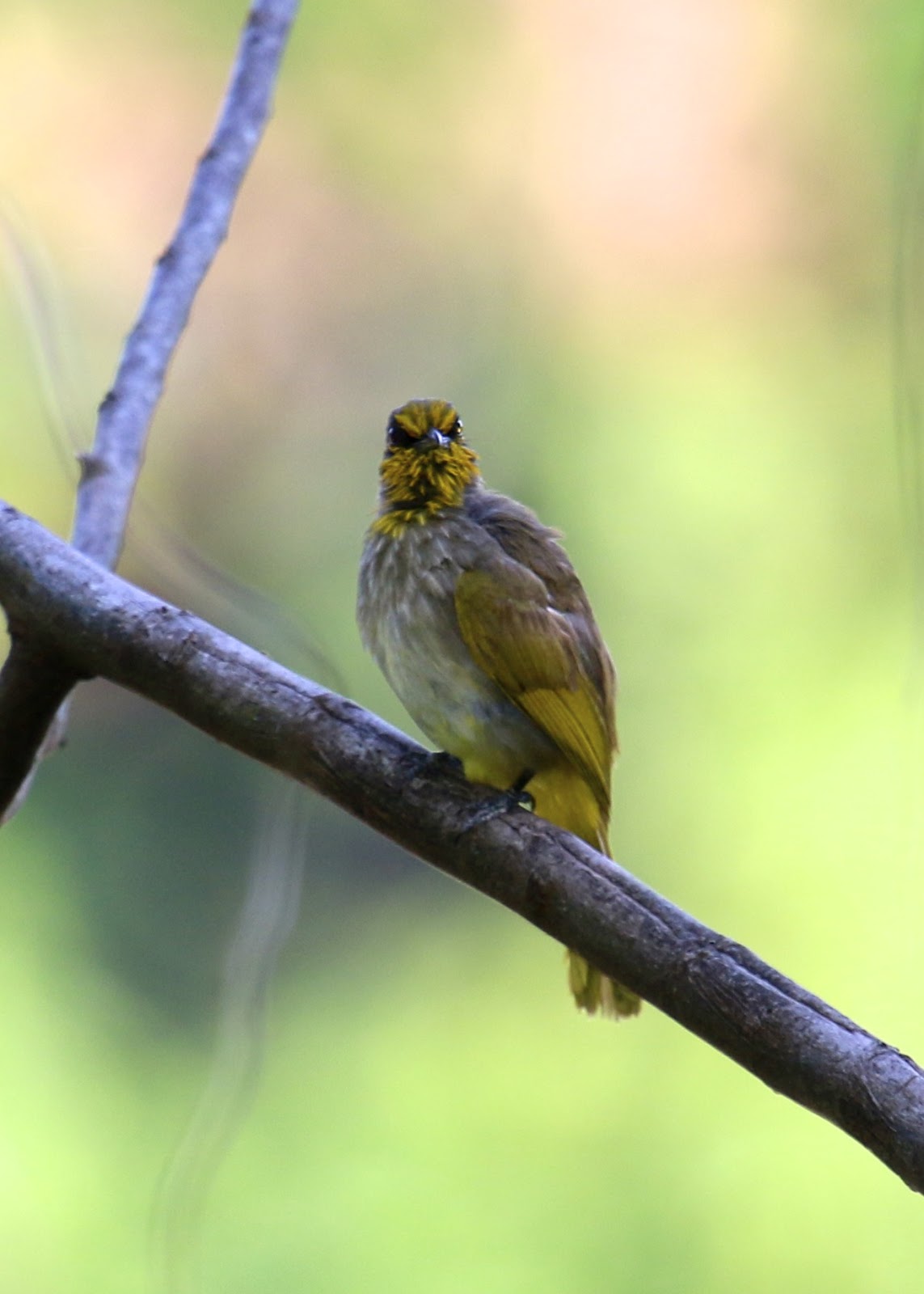
347 : Stripe-throated Bulbul


Stripe-throated Bulbul - Pycnonotus finlaysoni

I am surrounded by Bulbuls where I live in Dubai so its hard to get excited about these birds. This is a handsome enough species though common to this part of South-East Asia from Vietnam down around to Singapore and up into parts of China and Myanmar. I'd see these birds round the gardens at the lodge in Taman Negarra.


My life outside of stomping along jungle paths and floating down the river in my motor propelled  dug out tree consisted mostly of eating, trying to keep up with work with a very tenuous internet connection and then in the evening gently getting inebriated and then staying up far too late taking photographs of the local moths - "Moth Partee". They deserve a longer post in themselves but the general idea was to turn on the light on my back porch, head off for a big spicy dinner with several beers and then to return and try to see juts how many species of moth could be captured on film. Some epic "Partee" went on into the small hours - testing different configuration of lens, tripods and cameras.

Butterflys were certainly another draw - you didn't have to stray far from your table at the restaurant to capture some beautiful images.


Some days large flocks would gather at the edge of freshwater puddles to feed.


The music though again in the restaurant would drive me mad. They had one tape lasting about 90 minutes that went round and round. "Blue Blue my life is blue. Blue is my world when I'm without you". If you have ever had a naff song seared into your brain over a dozen meals by perhaps working in a restaurant then you will know the torture. I just have no concept of how they found these songs ? Were 60's euro-hits somehow de rigeur in jungle lodges in Malaysia. In a Stockholm syndrome type transference I spent a long time identifying and locating the various sh*t pieces of music that were inflicted on me in this solitary  mix tape. I know the full history of "Love is Blue" ("L'amor est bleu") as a recorded work eventually identifying a country and western version by Marty Robins that I preferred to the more classic Al Martino version. It was of course originally a euro vision song contest ditty.  I even listen to it (in numerous versions) at the gym and I use it as a soundtrack on my holiday slide show. The descent into madness while traveling alone has its own soundtrack.

To brighten things up I have to give a big tick to Malaysian food. Nasi Goreng became my staple. Rice usually chased down by a half dozen little side dishes of salty anchovy sauce, peanut satay and the like. Chilled beer, euro-trash and spicy food and butterflies. Not all bad.


I stopped short of ordering the local golden river perch delicacy. Given that I had seen signs for a fish conservation area and that the restaurant required 24 hours notice to lay on the perch banquet I thought it probably best to avoid. 


Stripe-thoated Bulbul, Pyconotus finlaysoni
Taman Negarra National Park, Peninsula Malaysia
9 June 2016

Saturday, 10 June 2017

346 : Black-and-Red Broadbill


Black-and-Red Broadbill - Cymbirynchus macrorynchus

Another star bird from the colourful middle of the fieldguide. Again picked up on a "float down" the river. These birds build a grass-woven pear shaped nest chamber suspended and hanging down from a branch. We came across one mid-stream. Presumably a great deterrent to snakes and other nest predators. I did not manage to get a decent picture of this bird so I really need a better picture another time when I journey back to South-East Asia.

While we are on the subject of snakes we may as well get the expedition's snake encounter out of the way !


I thought from my initial research that this is a Speckled Pit Viper (Trimeresurus Wagleri). I was dismayed that I found it on a webpage entitled "The Medically Important Poisonous Snakes of Malaysia" by Professor Tan who works in the Department of Molecular Medicine in the Medical Faculty of the University of Malaya. On this occasion though it was a frog and not me. I know nothing about snakes but Matte was having none of it and retreated off the boardwalk. He told me it was venomous.  It didn't take the fellow long to make short work of this quite large frog. Professor Tan seems to think its bite would cause pain and local swelling. Its not a Pit Viper though as the Vipers have a very triangular head - so what is it ? I have been through upwards of 50 snake families to find the answer ! Its a Common Bronze Back Tree Snake (Dendrelaphis tristis) - not venomous at all and from what I have now read it can just give you a little nip ! I guess we imagine the worst when we see a snake.


I estimate the snake was perhaps 4-5 foot long but probably no more than the size of an ordinary domestic water pipe - if that - perhaps no thicker than a thin branch or your thumb in places.


So Matte needn't have retreated 10 m up a slope - he was probably more likely to step on something else up there !


There is an awful lot of tail going on with this snake.


The colours were beautiful - thankfully with a 400 mm lens I did not have to get too close. At the time given Matte's reaction I though it was the sort of snake that would spoil your holiday pretty quickly.


The thing was beautiful though and when it decided it was time to go it was off - at time a full foot of its body up off the ground weaving around to find a way up off the boardwalk.


Matte honestly was a woose with this fellow which made me feel a lot better. Tramping around in the jungle in the dark though to get into position to try for a Pitta ? It makes you think twice. I certainly came away with a bit of reticence about the jungle. This guy didn't seem phased by us at all. I guess he was busy though ! In retrospect I will take a couple of lessons the next time I go somewhere as to which snakes are going to cause you a problem.

Black-And-Red Broadbill, Cymbirynchus macrorynchus
Taman Negara National Park, Peninsula Malaysia
June 2016


Sunday, 21 May 2017

345 : Whiskered Treeswift


Whiskered Treeswift - Hemiprocne comata

Treeswifts are like an ocean going ships at anchor. Unlike their cousins the true Swifts who spend the vast majority of their life on the wing - true Swifts mate, eat and even sleep on the wing - Treeswifts are the angels who have come down to earth. Each Treeswift adopts the crown of a tree as its home and sets up territory to capture whatever bugs and insects stray into the adjoining airspace. I watched one species of Treeswift in Sri Lanka fly in swooping rings around each of their home trees in the gardens of a great palace. This Treeswift was neatly placed in its tree next to a main road. Matte pointed it out for me on a driving trip out of the national park to try and pick up some different birds. This is a long range shot with a 400 m lens so you will have to excuse the clarity. The head markings are pretty unmistakeable even at this range.

Whiskered Treeswift, Hemiorocne comata
Just outside Taman Negarra National Park
June 4-6 2017

Saturday, 20 May 2017

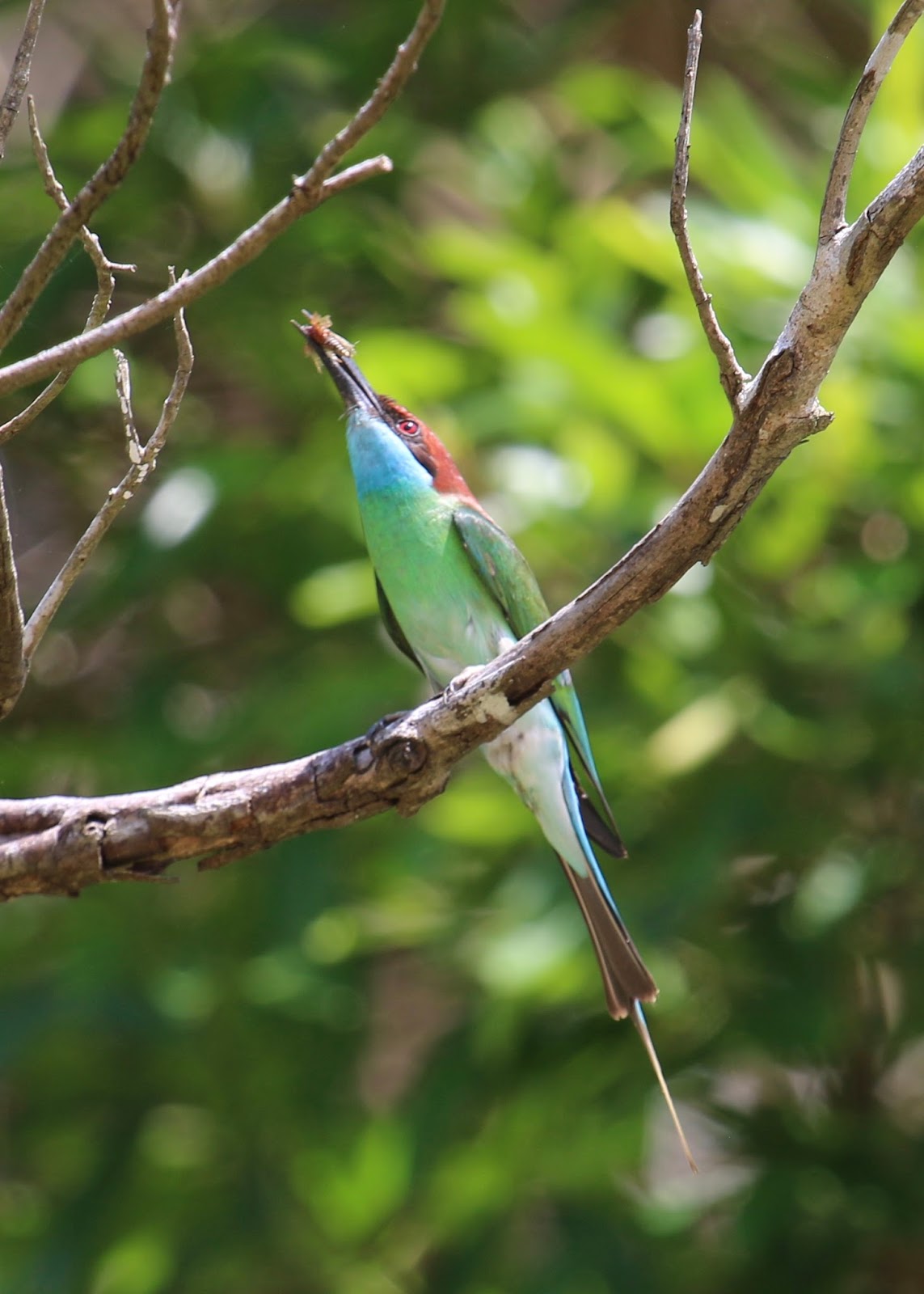
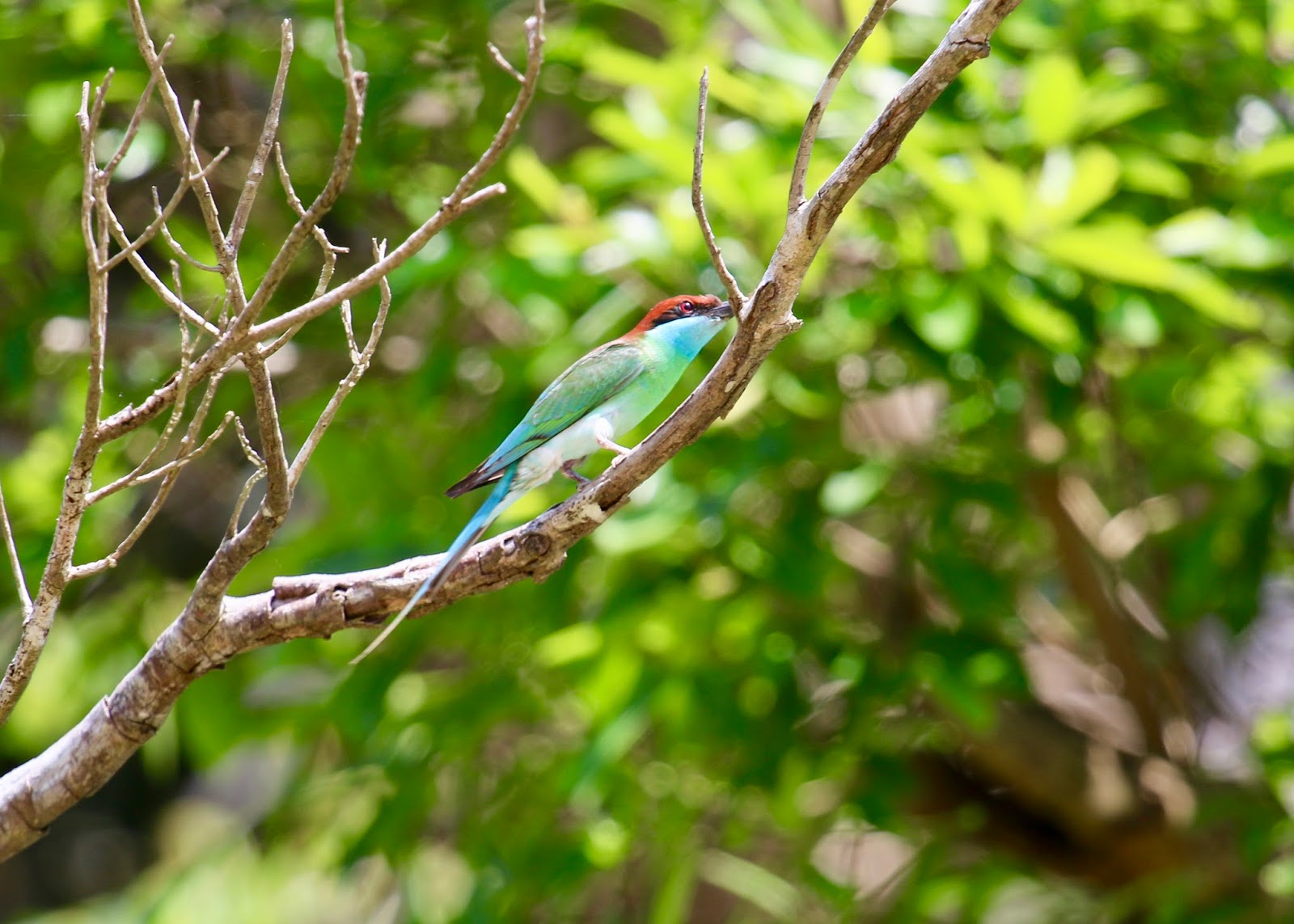
344 : Blue-Throated Bee-Eater


Blue-Throated Bee-Eater - Merops viridis

I am enjoying tapping up my birds again on this site after a long break. I have a big backlog of beautiful birds to capture. To stick into my online book like so many living stamps. It has been so long since I went to Malaysia (almost a year) that I had forgotten that as well notching up a couple of Hornbill species I added to my stunning collection of Bee-Eaters. Bee-Eaters have a very special place in the Daily Bird as the journey began with a Chestnut Headed Bee-Eater - bird number 1 in 2011 ! These have to be a favorite with all birders. If you are a British birder you are unlikely to see one until you venture over onto the continent where you will bump into our European Bee-Eater. If you make it on safari then a world of African Bee-Eaters opens up - to date I have managed to capture these charming Little Bee-Eaters. Or if you are dyslexic and live in the Gulf like me you can delight in these Little Green Bea-Eaters. My spelling is nothing if not atrocious. In November I am taking Jane to Zambia on a short safari. I know the camp we have chosen is close to a colony of Carmine Bee-Eaters. When I get a photo of one of those I will probably just collapse. They cannot be real but then again before I saw my first Bee-Eater in Italy on honeymoon I wasn't prepared for just how beautiful individual birds could be.

I was watching the BBC's Mexico series tonight and it looks like we will have to go to the Yucatan peninsula to see something called an Azure-browed Motmot. They nest inside collapsed limestone lakes and display with beautiful long pennant feathers. Their heads are crowned with iridescent aqua feathers set off with chocolate brown coloring. Not unlike our friend above. Mexico - I didn't know they had Howler Monkeys, Jaguars, Bears and Motmots - good old BBC.

Back to Bee-eaters. What is clear is that this whole family of Old World birds is a stunning jewelry box full of very special creatures. Treasure birds. When you are heading off somewhere new there is always the excitement of buying a new book - say Birds of South-East Asia or Birds of Southern Africa. for some taxanomic reason around the middle of each book there will be a collection of 4 or 5 plates gathered on which are all the Trogons, Parrots, Green Pigeons and Bee-Eaters. There is some science in the order of bird books which I cannot recall but it does seem as if all of the most special looking birds crowd together on just 4 or 5 pages somewhere near the middle - or perhaps its something to do with printing ?  So all of my bird books start with white, brown, grey, more brown, fawn, tawny, black birds and then oh wow ! - as if a bunch of primary school children with a new set of felt tip pens has been let loose the plate for the Bee-Eaters is dropped in to brighten up a rainy morning at school ... or a dark evening dreaming about a birding journey. No birder can ever tire of a Bee-Eater.


So this fellow was a compassionate gift from the National Park after I had managed to stumble my way through dense rainforest for 4 hours without getting a decent shot of anything. I did see elephant dung which was exciting but very old - but great to know that the pygmy elephants were there.

The forest knew that I had earned something decent other than my lunch and as we rounded a corner of the river both Matte and I started beaming and the instructions were given to cut the engine. All was quiet and we drifted past the perch and I started snapping away - with far more success than I had mustered during the rest of the morning. The sun was in the right place - I got a catch-light in the bird's eye. The bird was doing something interesting. It had caught a Bee and was rubbing out the sting on its perch. We drifted past - and then reversed back and I was able to check the shots and take another pass before the bird flew off. I have a bad habit of watching a bird fly away to see where it goes rather than trying for flight shots so most of my pictures are on perches !

All was now very good with the world and with me. The rainforest and the river with its towering trees was now a friend.


I cannot remember the name of this individual tree species but some were in flower and tiny petals would float down carpeting the trails and water. They must have been 60 m tall some of them. They reminded me of the trees in Loth Lorien. Shining white bark and these huge sprays of hundreds of thousands of tiny flowers.


I also knew I had a cracking guide who by the end of my short stay would turn out to be one of those guys who gives so much in 3 days that you are just sad to say goodbye. This guy loved the Park and knew every tree, bird, mammal and reptile.  He had seen a tiger once swimming across a small tributary when out in a boat with his father. Once in a lifetime - and he lives on the edge of the park. There are perhaps 10 tigers left in the forest today. He was also active with local conservation - if only more people in Asia could be in love with the forest and its birds. He also had much keener eyes than me, a smart phone with tape lures (recorded song) for every species we wanted to see (although none seemed to work for us when we tried - wrong season) and a good sense of humor. I asked him what were likely to see one day and replied "with some luck not too many Homo sapiens".


I think this is his best smile for the paying birder look. He hated snakes and thats a good story for another blog. I look forward to telling that one. I was better with the snake.


So by lunchtime on the first day I had decided that walking was bad and that boats were good. We took to Matte's car one afternoon for a bit a road trip out of the National Park which is another heart-breaking story. I'll leave it there for now with the Blue Throated Bee-Eater. Thats 5 species out of the 25 or so species worldwide so in Bee-Eater terms I am 20 % of the way there.  In general terms I am just scraping 3 % of the worlds birds logged on this site. Who is in any rush though. I didn't know until this evening what a Motmot looked like and I haven't had time to check the spelling yet.


Blue-Throated Bee-Eater, Merops viridis
Taman Negarra National Park, Peninsula Malaysia
4-6 June 2016

Wednesday, 17 May 2017

343 : Rhinoceros Hornbill


Rhinoceros Hornbill - Buceros rhinoceros

Big birds need big trees and often very big nesting holes which is why you won't find a bird like this in a local park. These birds require "extensive areas of primary green rainforest".  Weighing in at up to 3 kg for a female with a body length of 90 cm this has to rank as one of the most fabulous birds I have ever seen. My unicorn from the trip. "Trip" seems a bit of a weak word. This was a journey. We will leave the trips for the seaside.

So I spent an hour or so after dinner sitting and chatting with my guide, Matte. The plan for the next day was to meet at 7 am and to take a short boat trip up river to be dropped at the head of a jungle trail. The plan was then to spend 3 or 4 hours in the forest and to get "tuned" in and see what was about. Go on foot, carry my kit in and set up and get some first bird shots. I couldn't wait. Overexcited I had a Moth "Partee" - more on Moth "Partees" in another post. Nightime madness.


It was humid, foggy, and worse still I was having real issues with my camera - I began worrying that the the camera body had somehow become filled with condensation. There was a slight blur on the edge of everything. I discovered later after switching camera bodies that I had knocked a focus button. The numbers of times I have got into situations in the "bush" and then faced some technical issue. Buttons knocked, cards dropped, batteries flat. I was also packing some extra equipment - a directed flash and had been fussing about that half the night ! Everything I have read had taught me that taking shots in the rainforest was more like taking a picture of your dog in your kitchen at 5 am. with the roller blind closed. Flashes use a lot of battery power - the camera kit had expanded to industrial quantities of rechargeable, rechargers etc. It is now taking an hour to pack and checklist to pop out for a little "trip".

So on the boat chugged with me fussing over buttons and wiping lenses and generally getting worked up about seeing a Pitta and not being able to get the shot. I needn't have worried on the pitta front. They don't exist for me.


We were dropped on the banks of the river and then climbed up some dodgy log steps to enter into the forest- we soon swallowed up by the canopy and I can only describe it as another world. Towering trees, a path about a meter wide, wet, soil consisting of rotten leaves, thick steaming air and bouncing around at indiscriminate distances, heights, ranges and levels of clarity the birds. `You could not see horizontally more than say 3-5 yards at times due to the dense foliage. It was gloomy, it was hot - but it was a cacophony at birds at times. Other times eerily silent. Western man cannot survive in the rainforest. It is designed to wipe him out... for me in one morning. 

We trudged around that jungle trail for a long morning. I climbed over tree buttresses, got caught on spiky rattan, sweated, cursed fiddled and faffed with my camera. Strained my eyes into the gloom - what was better ? My steamed up glasses or my short sighted naked eyes. I discovered the joys of spiced coconut oil as an insect repellant and coolant. I missed seeing the deer that Matte spotted. I caught sight of the odd bird like shape but pretty much that was it. I learned a lot though - about my complete unfitness for trekking in the rainforest. My shirt was utterly drenched, underwear a giant sponge, the seat of my trousers covered in mud and sweat from slipping. My monopod started to bite into my shoulder. I could not to seem to find my footing, any technique of comfort for walking or carrying my gear - I couldn't find even a rhythm for breathing let alone operate my camera. "Working" in the rainforest with just a simple rig and lenses, flash and so on - nearly impossible. I had absolutely bitten off more than I could chew. I applied my common sense, brute strength, what was left of my intelligence, reason, even tried to charm and talk to the jungle - it was having none of it. It just beat me and my kit into submission. 

The fact that Matte was hacking at times let me know that we were on a little trodden path. It was a good trail apparently for birds as since a cave had closed due to a ceiling collapse earlier in the year there was no point to it for the ordinary trekker.

In 4 hours the net result of my labors that isn't blurred, rubbish and actually contains something that is discernible as a bird is below - I haven't even dared to try to identify this yet - almost a year later. In case I cannot and the net result of that 4 hours of pain, sweat and oh so English reassurances to Matte that "I'm fine, just a minute and then I will catch my breadth" was a blank. It wasn't in the end - we had a great little trip back on the boat that turned up a gem.


The net result of the 4 hour schlep was that  I saw 1 bird properly in 4 hours on foot followed by 10 minutes on a boat back (they call them in by mobile phone) where I then saw perhaps 30 birds. It was clear that a change of tactics was required. I decided that I wasn't cut out for the deep jungle and that I would literally kit myself up with a whole boat crew and cruise up and down the tributaries doing what Matte called "float downs" and using the boat as a photographic hide.

Before you lose faith in me it had been explained that I was in advance of the fig fruiting season so finding birds and getting decent shots in the jungle itself would prove pretty tough. There were plenty of easier trails to walk around closer to the camp and for the deeper jungle I could use the rivers and just focus on the photography rather than hauling myself through the bush. It turned out to be a good decision. Life changed after lunch ! A lovely lunch I might add as I became aware of the various boil like bites I had picked up that morning.

I would be giving up on the chance of seeing birds like e.g. Great Argus and Gurneys Pitta but I had heard the former a long way off and could not imagine how you would get to a Pitta even if it was just 30 yards off the trail ? I have read a book the Jewel Hunter on Pittas also by Chris Goodie which had been my inspiration for visiting Taman and he would merrily speak about "going in". Going off the trail and then just setting up in a bush surrounded by snakes and creepy crawlies and staking out calling birds. No way ! Not yet - not without a lot more rainforest birding under my belt. I was going to throw an engine and a whole dug out log at the issue - chuck cash at the problem as I always do. I was crewing up.

So in the afternoon after a delicious lunch (food I think another time) we started our new tactic of "drifting down".


The technique was to cruise up a tributary to the main river and then turn the boat around and turn its engine off and literally just drift down. It is the most peaceful and fantastic way to see the rainforest. "Margins" of habitat are always good places for birds. They provide a road for easy flight, opportunities to project song and for feeding - and you just see more. The bulk of my rainforest birds resulted from "drifting". I got some superb shots that will form the backbone of my posts from Taman Negarra. I felt like a fraud at first but then I thought "No" - actually you tried it - the jungle schlepping with all the kit and it didn't work. You can soldier on or you can change tactic and get what you came for - not heat exhaustion and a broken limb when you fall down a slope but photos for the task. The other point I failed to mention is that the jungle is hilly ! Plus I was kitted out in leech socks and it was permanently wet. I fear leeches - I had been lucky so far. My fear of the jungle overtook over lunch. It was time for a nice comfy boat with a crew of 3 and a supply of biscuits and cool drinks. Thats more like it.

So off we drifted - I will show some more shots of the river scenery in a different post. Lets focus on the prizes.

My middle aged wisdom soon paid off. A pair of calling Rhinoceros Hornbills. This is the female.


Soon joined by the male. You can see the greater recurve on the casque above the bill - nobody knows what the casque is for. The orange and red color is from a preen gland - it must be the result of mutual preening - the birds rubbing each others bills - let me help you with your rouge.


Finally I got a shot of them together. Absolutely stunning.


I have written about hornbills in my past postings, how they raise their young, habitat needs, and so on. If you want to dive into the world of hornbills and marvel at some diversity the original Daily Bird pre-techno crash has some good postings on the Malabar Pied  , Indian Grey, Southern Ground, Von Der Decken's, African Grey , Red-billed , and Crowned. This is the thing I love most about the Task. Three continents and five different journeys to capture photographs of 8 Hornbill Species. There are 62 species of Bucerotidae. I have a hornbill collection in my heart which stretches from Ruaha across the Serengetti the Western Ghat mountains in India and down through Sri Lanka and then out and across the ocean to Peninsula Malaysia. All mine.

This is is the first time I have really seen a pair together and certainly the longest I have travelled on my own to get a shot. I can still remember the elation - I have a short film which I will need to edit down in order to post up. Love these shots. A top moment.

Rhinoceros Hornbill, Buceros rhinoceros
Taman Negara National Park, Peninsula Malaysia
June 2016